 Editor’s NOTE: What follows are a series of headlines, synopsis and links to a series of articles regarding the poisonous nature of that which we are expected to ‘eat.’ Notice that there is only reference to GMO – Genetically Modified Organisms – NOT Genetically Modified FOODS. It’s all designed to confuse the mind. Just because you fill your belly does not mean that you are feeding your body of the necessary nutritional foods that have been provided by nature and real farmers for years.
Bon Appétit my friends. ~ J.B.
Whole Foods goes ROGUE… partners with Monsanto to kill GMO labeling across America and replace with fake labeling deception
 IMPORTANT UPDATE: Whole Foods was just caught blatantly LYING about everything covered in this article. CEO Walter Robb has been captured on video admitting total support for Monsanto-engineered GMO fake labeling law that kills Vermont GMO labeling bill. Whole Foods… (Continue to full article)
Victory! Judge closes industry loophole, barring pesticides from compost used in organic food production
 In a victory for organic consumers, a federal judge has tossed out a rule change by the U.S. Department of Agriculture (USDA) that permitted the use of compost containing synthetic pesticides in growing organic foods. “The court’s decision upholds the integrity of… (Continue to full article)
Conventional corn and soybean farmer says consumers have right to know if food contains cancer-causing GMOs
 Sometimes it takes an average person with direct experience of a situation to put things in perspective in such a way that anyone can understand – without a lot of industry jargon or double-talk – by simply speaking the truth in plain, commonsense terms. Such… (Continue to full article)
London grocery stores prepare to sell Fukushima rice despite health concerns over radiated food
 Rice grown in the zone surrounding the still-radioactive Fukushima Daiichi nuclear power plant will now be sold in London grocery stores, the European Union (EU) announced in late June. In March 2011, the Fukushima plant suffered multiple meltdowns after being struck… (Continue to full article)
Midwestern farmer warns: GMOs have drained BILLIONS of dollars from rural economies while monopolizing agriculture
 George Naylor, a farmer and board member of the Center for Food Safety and the Non-GMO Project, has cultivated corn and soybeans on his family farm near Churdan, Iowa, since 1976. Like many others, George made the decision never to raise genetically modified (GM) crops… (Continue to full article)

 When the average person makes the decision to add a nutritional supplement to their diet, a multivitamin is likely to be the first choice. That’s because to most people it feels like “taking out insurance” on their health.
 Many aspects of the GOP’s newly proposed A Better Way healthcare plan would improve the health system. But “A Better Way” seems to mean “Much of the Same” when dealing with Food and Drug Administration regulation.
  Energy companies are billing them as the “green” solution to traditional meters. But are so-called “smart” meters really all that smart? And, more importantly, are they really as safe as we’re all being told they are?
  For the past 16 years, we have tried desperately to keep “politics” out of and off of Dr. Kelley’s website – however it appears that over the years and the decades – politics has injected itself into every aspect of our lives – most specifically into the world of OUR health and well-being. What follows is another example – in this case – short-changing the American grower (of healthy food) in order to keep others into our pockets. What is the reliability of the food we are importing? How healthy is it? How much has Monsanto stuck their filthy hands all over? Read on… ~
 Food tastes better than Soylent. On that, there is universal agreement. Bland in flavor but audacious in concept, everything else about the beige food replacement is fiercely contested. Foodies decry the decline of experiential eating, cultural critics bemoan the loss of communal mealtimes, and others warn of techno-hubris. There have also been questions about Soylent’s nutritional content, and yet, the company’s proprietary mix is almost certainly an improvement on the average North American diet.
 Seven refugees with active tuberculosis (TB) were diagnosed shortly after their resettlement in Idaho between 2011 and 2015, according to the Idaho Department of Health and Welfare.
 A woman decided to sue the Irish government to compel it to withdraw the license for Gardasil, Merck’s HPV vaccine, after her daughter allegedly suffered from “horrendous adverse effects,” following the latter’s vaccination under the Irish school vaccination program.
  In August 2015, Turing Pharmaceuticals and its then-chief executive, Martin Shkreli, purchased a drug called Daraprim and immediately raised its price more than 5,000 percent. Within days, Turing contacted Patient Services Inc., or PSI, a charity that helps people meet the insurance copayments on costly drugs. Turing wanted PSI to create a fund for patients with toxoplasmosis, a parasitic infection that is most often treated with Daraprim.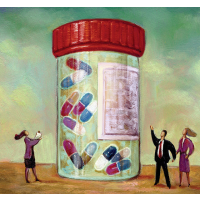
 Johnson & Johnson is being sued by more than 1,000 women who developed ovarian cancer after using the company’s Baby Powder product. The lawsuit is based on the assertion that the company knew their product was associated with an increased cancer risk but deliberately withheld that information from the public.
  Major pharmaceutical companies have been feeling intense political heat in the past year over skyrocketing drug prices, with some lawmakers and politicians threatening congressional or administrative action to rein in those costs.
  The study of 115 specialty drugs found that a year’s worth of prescriptions for a single drug retailed at $53,384 per year, on average, in 2013 — more than the median U.S. household income, double the median income of Medicare beneficiaries, and more than three times as much as the average Social Security benefit in the same year. The report was prepared by the AARP Public Policy Institute to highlight the impact of drug prices on seniors.