
 A new study published October 22 (2014) reinforces once again that olive oil is one of the best oils for cooking compared to other seed oils. Researchers based their conclusion on a few different factors, including nutritional content and the oil’s ability to maintain quality under high temperatures.
Published in the American Chemical Society’s (ACS) Journal of Agricultural and Food Chemistry, scientists note that various oils have different physical, chemical and nutritional properties that can be degraded under high heat and repeated use.
Many cooking oils can become impaired while heating in the pan or frying, and the food that you’re cooking can actually also lose its nutritional content, making your choice of oil critical for producing a healthy dish. Continue reading
 A handful of almonds a day could be the key to a longer and shapelier life.
 Decaffeinated drinks have been touted as a healthy alternative for several decades at the behest of the chemical industry, but these drinks are often more dangerous than the unmodified versions.
 Unbeknownst to most, a Copernican revolution has already taken place in cancer theory. Today, the weight of evidence indicates that plants and not chemicals are the solution for reversing the global cancer epidemic.

 If only old people would just hurry up and die — that’s the point of view for most proponents of socialized medicine around the world. Case in point is British doctor Richard Smith, who says
  The system for researching new cancer treatments is ‘broken’, one of Britain’s top academics has claimed.
 A glass of red wine, a handful of peanuts or a nibble of chocolate could protect against osteoporosis.
 Artificial sweeteners may disrupt the body’s ability to regulate blood sugar, causing metabolic changes that can be a precursor to diabetes, researchers are reporting.
 At this time of year, we have so much to be merry about. In the last couple of decades, there has been enormous progress in medical treatments, and as a result several of my friends are still alive who surely would have died amid the technology of yesteryear. Every invention of a new medical procedure, every discovery of a new medicine, is an example of what God gives to mankind – the gifts of intelligence, insight and creativity. It’s way too easy to overlook what that kind of progress means to all of us and our families.
  As health officials scramble to explain how two nurses in Dallas became infected with Ebola, psychologists are increasingly concerned about another kind of contagion, whose symptoms range from heightened anxiety to avoidance of public places to full-blown hysteria.
 Women with breast cancer do not increase their survival chances by having a double mastectomy, researchers claim.
 A new report shows that three of the top preventable risk factors for cancer have to do with what we eat and how often we move.
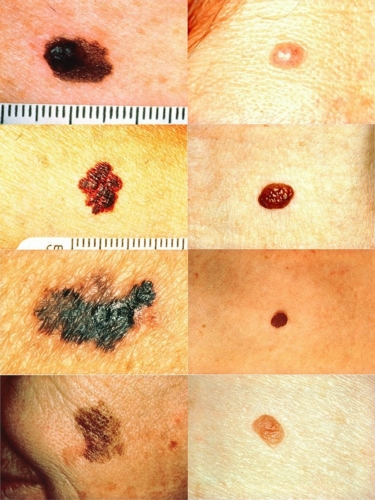 The left column shows examples of melanomas. The right column shows examples of normal moles. These examples are not comprehensive, and you should have a dermatologist take a look at any moles you’re concerned about.