
(Plus, a few honorable mentions.)
 Vegetables are a cornerstone of a healthy diet, but with endless options at the market and seasons that never stop shifting, knowing which ones to always keep on hand isn’t always obvious. We asked two registered dietitians to name their standout pick (and share a few honorable mentions) to settle the debate once and for all. Spoiler: Eat your greens.
~ How Vegetables Impact Your Brain, Heart, and Gut Health ~
Before diving into the standout picks, it helps to understand just how much vegetables do for your brain, heart, and gut. “Vegetables contain nutrients like vitamins, minerals, fiber, proteins, carbohydrates, fats, and polyphenols that impact all systems in the body, including the brain, heart, and gut,” explains Avery Zenker, MAN, registered dietitian and writer at MyHealthTeam. “Every vegetable provides an array of nutrients that each have unique roles in the body. It’s not just the individual nutrients that matter, but the entire food matrix of vegetables.”
Vegetables also contain antioxidant and anti-inflammatory compounds that benefit the brain by reducing oxidative stress, explains Johannah Katz, registered dietitian at Consumer Health Digest. “Diets rich in vegetables have consistently been associated with slower cognitive aging and better memory outcomes,” she says. Those same anti-inflammatory effects extend to heart health, since inflammation is one of the primary drivers of cardiovascular disease.
“From a gut health perspective, vegetables are one of the most important sources of dietary fiber and prebiotics,” Katz says. “These compounds feed beneficial gut bacteria, supporting microbial diversity and the production of short-chain fatty acids like butyrate, which play a role in maintaining gut integrity, reducing inflammation, and even influencing brain health through the gut-brain axis. In many ways, vegetables act as a bridge between gut, brain, and cardiovascular health because of their shared impact on inflammation and metabolic regulation.” Both experts pointed to leafy greens and cruciferous vegetables as their top choices for supporting all three.
~ The Best Vegetables for a Healthier Brain, Heart, and Gut ~
Leafy Greens
The order you eat your food in also matters. Start with the most fibrous foods first, like your leafy greens, then fats and proteins, and end on carbs.
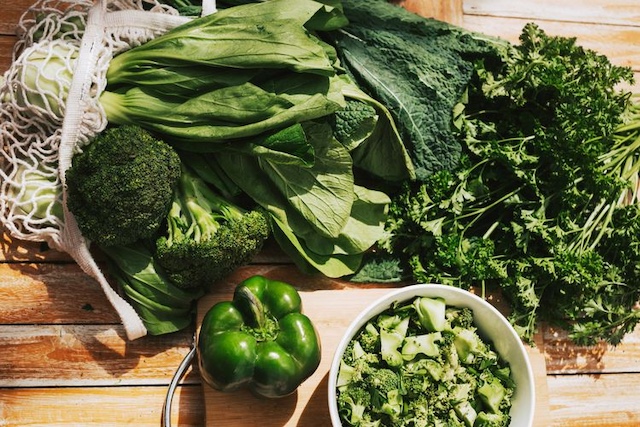
For Zenker, leafy greens are the clear standout. “Leafy greens are consistently linked with improved health outcomes, especially for heart, brain, and gut health,” she says. “Common leafy greens with particularly impressive health benefits include kale, spinach, arugula, Swiss chard, collard greens, beet greens, bok choy, and romaine lettuce.” It’s no coincidence that diets designed to support overall health—like the Mediterranean diet—tend to be rich in leafy greens.
The vitamins, minerals, and polyphenols found in leafy greens also work together to amplify their benefits. “Leafy greens provide fiber, magnesium, folate, iron, calcium, potassium, vitamin A, vitamin B9, and vitamin K, among others,” Zenker says. “Magnesium helps regulate blood pressure, supports healthy heart rhythm, and promotes brain energy. Vitamin A supports the integrity of the gut lining. Iron is essential for healthy blood cells and transporting oxygen to the brain, gut, and heart. Calcium promotes healthy muscle function and nerve signaling throughout the body, including the heart and digestive organs.”
Broccoli Sprouts
 Katz, meanwhile, makes the case for cruciferous vegetables—specifically broccoli sprouts. She credits their high concentration of sulforaphane, a bioactive compound that regulates antioxidant levels, supports the gut microbiome, and aids the body’s detoxification process, all while reducing inflammation. “Broccoli sprouts are the most potent natural source of sulforaphane precursors, making them a uniquely powerful option compared to mature broccoli, though both are beneficial in their own ways,” Katz says. “Cruciferous vegetables also provide fiber and glucosinolates, which support microbial diversity and the production of beneficial metabolites in the gut.”
~ Honorable Mentions ~
Beyond leafy greens and cruciferous vegetables, both experts flagged three additional picks with an outsized impact on brain, heart, and gut health: beets, garlic, and onions. “Beets contain nitrates, which are converted to nitric oxide in the body,” Zenker explains. “Nitric oxide lowers blood pressure, supporting cardiovascular health. Improved blood flow to the brain supports cognition, and to the gut promotes healthy digestion and nutrient delivery.” Beets are also high in polyphenols that help reduce inflammation and lower cholesterol, blood pressure, and plaque buildup.
 Katz rounds out the list with garlic and onions. “Garlic and onions provide sulfur-containing compounds that support cardiovascular health and may have prebiotic effects that benefit the gut microbiome,” she says. Ultimately, though, variety is the goal—building a diverse vegetable rotation means your body gets a wider range of compounds and their combined benefits across all three systems.
Written by Ria Bhagwat for Real Simple ~ May 22, 2016