
Cells in lungs and bone are ‘more likely to be attacked by the disease’

Scientists have discovered that when cells are ‘squeezed’ inside stiff, rigid body tissues, such as the lungs, it is more vulnerable to the genetic mutations that can trigger cancer
Scientists have discovered that when cells are ‘squeezed’ inside stiff, rigid body tissues, such as the lungs, it is more vulnerable to the genetic mutations that can trigger cancer
There are dozens of different forms of cancer, some far more deadly than others.
The disease can invade any part of the body, and appears when cells grow out of control and crowd out healthy ‘normal’ cells.
But, cancer is not just one disease. It takes many forms, starting in the lungs, the breast, colon, even the blood. Some forms of the disease grow and spread quickly, making them more deadly.
While scientists understand that types of the disease are different, why that is so remains a question experts strive to answer.
Now a new study, has shed some light on the issue.
A team of scientists have discovered that when cells are ‘squeezed’ inside tough, stiff body tissues, such as the lungs and bone, they are more vulnerable to the genetic mutations that cause cancer.
They believe the reason lies in the stress forces that act on cancer cells when they move and divide.
Researchers said the more rigid the tissue structure, the harder it is for the body to repair the damaged DNA, or genetic mutations.
Tumours arising in stiff tissues exhibited mutation rates and chomosomal variations 100 times higher than those seen in soft tissues, the team discovered.
Dr Jerome Irianto, from the University of Pennsylvania, said: ‘Basically, we hypothesise that stiffer tissues with their denser matrix and smaller constrictions cause more nucleus deformation that damages the nucleus.’
To investigate the effect, the researchers set up an experiment in which cancer cells were made to migrate through thin plastic filters pierced by tiny holes.
When the cells had to force their way through three micrometre-wide holes, they accumulated more DNA damage than when they passed through larger eight micrometre-wide holes.
Further experiments showed that DNA repair proteins were prevented from doing their job by too much squeezing.
‘What we are addressing right now is whether this constricted migration with molecular damage and segregation will translate to genomic instability, which is a hallmark’ of cancer, Dr Irianto added.
‘Cancer needs to invade to spread, and that invasion could itself cause mutations.’
The research was presented at the Biophysical Society’s annual meeting in Los Angeles.
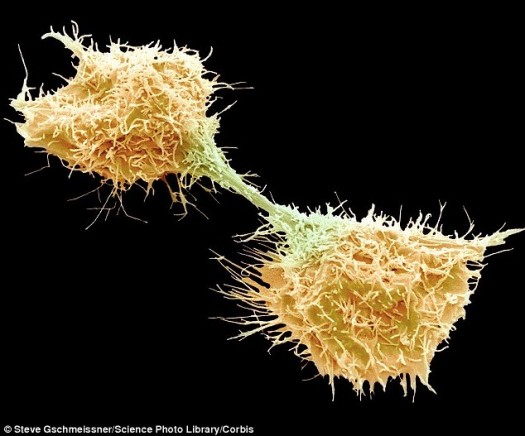
They believe the reason lies in the stress forces that act on cancer cells when they move and divide (illustrated, cancer cells dividing). Researchers said the more rigid the tissue structure, the harder it is for the body to repair the damaged DNA, or genetic mutations
Written by Lizzie Parry and published on the Daily Mail, February 28, 2016.
FAIR USE NOTICE: This site contains copyrighted material the use of which has not always been specifically authorized by the copyright owner. We are making such material available in our efforts to advance understanding of environmental, political, human rights, economic, democracy, scientific, and social justice issues, etc. We believe this constitutes a ‘fair use’ of any such copyrighted material as provided for in section 107 of the US Copyright Law. In accordance with Title 17 U. S. C. Section 107, the material on this site is distributed without profit to those who have expressed a prior interest in receiving the included information for research and educational purposes. For more information go to: http://www.law.cornell.edu/uscode/17/107.shtml“